How to Tailor Your Resume for Each Job (Without Hours of Work)
Learn how to tailor your resume for each job in under 10 minutes. The 3 things that actually matter + the Master Resume method that saves hours.
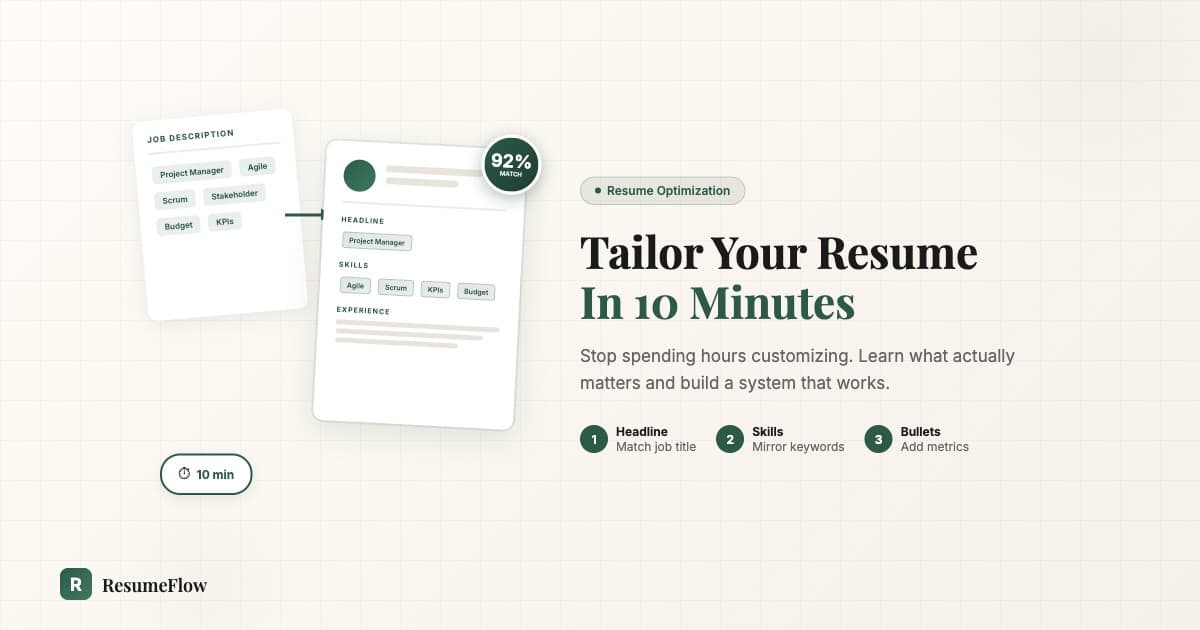
You know you should tailor your resume for each job. Everyone says so. But when you're applying to 10+ jobs a week, who has time to rewrite the same document over and over?
Here's the trap most job seekers fall into: you either spend an hour per application (and burn out after a week), or you blast out the same generic resume to 50 jobs and hear nothing back. Both options suck.
There's a third way. You can tailor your resume for each job in under 10 minutes—if you know what actually matters. This guide shows you exactly what to change, what to ignore, and how to build a system that makes customization fast instead of painful.
Why Generic Resumes Don't Work Anymore
Let's be honest about the math.
The average corporate job posting gets 74 applications. Popular remote roles? Hundreds. Sometimes thousands. Recruiters can't read them all. So they don't.
Instead, 98.4% of Fortune 500 companies use Applicant Tracking Systems to filter candidates before a human ever looks. These systems scan your resume for keywords that match the job description. No match? No human review. Your resume goes into a digital black hole.
Here's what that means in practice: 75% of resumes get rejected by the ATS before anyone sees them. Not because the candidates are unqualified—but because the keywords don't line up. Learn more about what ATS scores actually mean and how to improve yours.
And even if you survive the robot, human recruiters spend about 6-7 seconds on the initial scan. Six seconds. They're not reading—they're pattern-matching. Looking for job titles that fit, skills that match, numbers that pop.
A generic resume makes them work too hard to see the connection. A tailored resume makes it obvious.
The data backs this up: candidates who tailor their resumes see a 55% increase in callbacks. And 43% of recruiters say they'll immediately reject a resume that looks "obviously generic."
Sending the same resume to 50 jobs isn't a strategy. It's a lottery ticket with terrible odds.
The 3 Things You Actually Need to Change
Here's the good news: you don't need to rewrite your entire resume for every job. That's the myth that makes tailoring feel impossible.
In reality, about 80% of your resume stays the same. The other 20%? That's where the magic happens.
1. Your Headline (Match the Job Title)
The title under your name is the single highest-ROI edit you can make. Matching the exact job title from the posting gives you a 10.6x boost in getting noticed.
If you're a "Marketing Manager" applying for a "Growth Marketing Lead" position, change your headline. If the job says "Senior Software Engineer" and your resume says "Developer," swap it.
This isn't lying—it's speaking the same language. Just make sure you actually have the skills.
2. Your Skills Section (Mirror the Keywords)
ATS systems are looking for exact matches. "Project Management" and "Managing Projects" might mean the same thing to you. To a keyword filter, they're completely different.
Pull the top skills from the job description—usually found in "Requirements" or "Qualifications"—and make sure those exact phrases appear in your skills section. Move the most relevant ones to the front of the list.
Recruiter Tejal Wagadia puts it simply: "Tailoring shouldn't take more than five minutes. If it takes longer, you're being too broad. Use simple keyword swaps to align with the job description."
3. Your Top Bullet Points (Emphasize What's Relevant)
You don't need to rewrite every bullet. Focus on your current role and your most relevant past role.
Move the most applicable bullet points to the top. If the job emphasizes "client relations" and your resume says "customer service," change it. If they want "data analysis" and you have experience with "reporting and insights," mirror their language.
Career coach Adam Karpiak explains why: "Vagueness kills. When you give context, it allows the reader to see your experience's relevance to the job you're applying to."
What NOT to Change
To keep this under 10 minutes, know what to skip:
- Education — Unless you're a new grad, leave it alone
- Older jobs — Experience from 10+ years ago rarely gets scrutinized for keywords
- Formatting — Once you have a clean ATS-friendly template, don't mess with fonts and margins
- Contact info — Obviously
The goal is strategic editing, not creative writing.
The 10-Minute Tailoring Method
Here's the exact process. Time yourself the first few times—you'll get faster.
Step 1: Decode the Job Description (2 minutes)
Don't read the whole thing. Scan for data.
- Identify the top 3 hard skills (usually repeated multiple times)
- Look for software names, methodologies, certifications
- Use Ctrl+F to count keyword frequency—if "project management" appears 5 times, it's non-negotiable
Step 2: Update Your "Front Window" (3 minutes)
The "front window" is the top third of your resume. It's the only part guaranteed to be seen in the 6-second scan.
- Change your headline to match the job title
- Tweak your summary to mention the top 3 skills you identified
- Reorder your skills section so the JD keywords appear first
Step 3: Optimize Your Bullets (4 minutes)
Focus on your most recent role only.
- Move the most relevant bullet to the top
- Swap any synonyms to match the JD's language exactly
- Make sure your top 2-3 bullets have numbers (metrics always win)
Step 4: Save and Submit (1 minute)
Save as "Resume_[Company]_[Role].pdf" so you don't lose track of versions.
Total time: under 10 minutes. Repeat for each application.
Tools That Make This Even Faster
The manual method works. But if you're applying to a lot of jobs, it gets tedious. This is where tools help.
The problem with manual tailoring: You're doing the same keyword comparison in your head every time. You're guessing whether you've hit enough matches. And you're spending mental energy on formatting instead of strategy.
What AI tools do differently: They automate the gap analysis. Upload your resume, paste the job description, and the tool tells you exactly what's missing.
ResumeFlow takes this further. Instead of filling out forms, you chat naturally about your experience. The AI structures your resume, scores it against the job description in real-time, and shows you which keywords to add. Most users hit 85%+ match in under 10 minutes—without rewriting from scratch.
The workflow becomes: paste JD, see score, make adjustments, export. That's it.
For high-volume job seekers applying to 20+ roles, this is the difference between sustainable and burnout.
The Master Resume Trick (For Repeat Tailors)
If you're tailoring regularly, here's a system that changes everything: the Master Resume.
A Master Resume is a document you never send to employers. It's your complete professional history—every job, every project, every skill, every bullet point you've ever written. It can be 5 pages, 10 pages, whatever.
The magic: you keep multiple versions of key bullet points.
- Version A (Leadership): "Led a team of 5 engineers to ship Feature X..."
- Version B (Technical): "Architected the backend for Feature X using Python..."
- Version C (Outcome): "Reduced system latency by 40% by optimizing Feature X..."
When a new job comes up, you don't write new content. You open your Master Resume, "Save As" with the company name, and delete what's irrelevant. Deletion takes seconds. Writing takes hours.
This flips the mental model from "creation" to "subtraction." And it means you never lose good content—it's all stored in one place.
Wrapping Up
Tailoring your resume for each job isn't optional anymore. The ATS filters demand it. The recruiters expect it. And the data proves it works—55% more callbacks, 10x visibility boost for title matches.
But it doesn't have to take an hour per application. Focus on the 20% that matters: headline, skills, and top bullets. Build a Master Resume so you're editing, not writing. Use tools to automate the gap analysis.
The quick version:
- Decode the JD for the top 3 keywords (2 min)
- Update your headline and summary (3 min)
- Mirror language in your top bullets (4 min)
- Submit (1 min)
Ten minutes. Not ten hours.
Want to see how your resume scores against a real job description? Try ResumeFlow free. Paste the JD, get your match rate, and see exactly what to change. No forms. Just results.
Sources: Jobscan 2024 ATS Report; Cultivated Culture Career Research; LinkedIn Hiring Data; Tejal Wagadia (Recruiter); Adam Karpiak (Recruiter)
Ready to build a better resume?
Try ResumeFlow and create an ATS-optimized resume in minutes.
Get Started Free